Wednesday, April 29, 2009
And The Winner For Best Blog About Manga in 2009 Goes To...
Kate Dacey, one of my all-time favorite writers about manga, is back with a new website, The Manga Critic. Kate kindly invited me to take part in a round-table discussion about good recent reads along with several of my other favorite manga bloggers. Go check out the site, and make sure to read Kate's hilariously honest bio about her origins as a manga fan and critic!
And to expand on what I said about Kekkaishi 16 on Kate's site, a good example of how creator Yellow Tanabe defies shonen expectations occurs in this volume: Tokine, the female kekkaishi, is trapped inside a mystical black box. Yoshimori, the younger, male kekkaishi who patrols the same area as Tokine, vows to rescue Tokine no matter what it takes. Just as Yoshimori is about to lose it die to worry, Tokine appears behind him. She was able to escape the trap on her own by stretching her supernatural abilities to new limits. So the stereotypical "damsel in distress" scenario wasn't used to motivate the hero; it was actually employed to show that the female protagonist was competent and capable of "powering up" when the situation demanded it. Imagine that!
This is one of the main reasons I love Yellow Tanabe's Kekkaishi. As much as I can get lost in a good, well-executed formulaic shonen series, it can still be frustrating when everything occurs in a rote, predictable pattern. By having things play out in unexpected ways (at least within the scope of shonen manga), Tanabe succeeds in keeping readers on their toes. (Another good example of this occurred last volume when a young child was abducted by the villain. Instead of just using the imperiled child as a cheap ploy to ratchet up reader anxiety, Tanabe had the young girl use her wits and abilities to outsmart the bad guy. Again, a clever subversion of genre expectations resulted in a surprisingly satisfying read.)
Labels: "I am perfectly convinced by it that Ms. Dacey has no defect.", Kekkaishi, My Favorite Bloggers
9:17 AM | |
Thursday, April 16, 2009
The Sensational Character Find of 2009
Introducing... Lil' Ropey!

A young Blair Witch, before settling on
sticks and branches as her preferred media.

"Run, run as fast as you can!
You can't catch me, I'm the braided hemp man!!"

Ropey throws the penalty flag on the ayakashi team's flagrant foul.

Ropey may look all cute and cuddly,
but he will mess you up if you cross him.
Special BONUS sensational character find! And if you think Lil' Ropey is tough, wait til you get a load of his big brother, Lariat Lad!

"The rope that walked like a man!!"
Is it too early to hope for a volume of side stories devoted to the amazing Rope Brothers?
All images from the awesome Kekkaishi volume 15, which also features a creepy Medusa muppet, Dark Shogun Warrior, and nightmare-inducing black boxes.
Labels: Face-Kicking, Kekkaishi, Manga, Sensational Character Finds
10:32 PM | |
Monday, June 16, 2008
What Others Are Saying About Books I've Read But Was Too Lazy To Review Myself
Sometimes it's just easier to react to others' reviews than to start my own...
Bleach 23 - Michelle at Soliloquy in Blue gives the book a C, which is probably a fair grade once I calm down and evaluate matters rationally. So far the Arrancars do seem more goofy than intimidating, and the fight scenes do feel a little boring and stale, especially after sitting through so many of the same types of battles during the Soul Society arc. And what could have been a touching character development moment for Orihime is marred by some completely unnecessary faux-lesbianism fanservice. My only hope is that all the cross-cutting to different characters being tracked by various Arrancars will set up an interesting and intense coordinated attack where our heroes are unable to come to each other's aid. (Davey C. Jones, on the other hand, can't find enough exclamation points to use in praising this installment. And "I don’t know how Ichigo is going to make it out of this one"? Really??? You don't think it'll have something to do with tapping into a previously undiscovered well of strength and/or new ability? And I thought I was a gushing Bleach fanboy.)
Parasyte 3 - Both Carlo Santos and Matthew Brady were a bit bored with this volume, but I thought book three advanced the series in interesting ways. Of primary interest was the ongoing change in Shin's personality due to bonding with Migi. It seems that Shin's humanity is slowly slipping away as the ongoing integration with his parasite causes him to be become more efficient and emotionless. I also liked the development of the government finding out about the parasites and devising a test that will reveal if someone's been infected or not. And as Connie at Slightly Biased Manga reminded me, the media's representations of the "mouth-heads" are pretty hilarious.
Kekkaishi 13 - Isaac Hale give the book a B+ and notices the similarities and differences between the respective opening story arcs for Kekkaishi and that other series about superpowered teenage demon hunters who hang around their school a lot. (I don't really have anything to add to Isaac's review — I just want to remind everyone that they should be reading Kekkaishi.)
Sgt. Frog 15 - Holly Ellingwood at Active Anime clearly enjoys the book, but her review probably won't be much help to readers wondering if they'd enjoy this installment of the series. The bulk of the review is so generic it could apply to any volume of Sgt. Frog. In fact, the review makes me wonder if the reviewer read volume 15 at all. Almost all of the third paragraph is copied word-for-word from the book's back cover blurb, just rearranged in a different order. And the only item not lifted directly from the book seems to be a reference to something that happened in volume 14: "On a recent summer day, Fuyuki’s research led him to another boy, whose situation was eerily like Fuyuki and Keroro’s." That sounds like a description of Encounter CXII "A Midsummer Mix-Up", which was in the previous book.
Myself, I thought Sgt. Frog volume 15 was a fine return to funny frog-like form. The chapter about fukuwarai was hilariously absurd, and indirectly educational, as it taught me something about Japanese culture I didn't know before. The episode with Giroro's kitten assuming human form and taking over the unit was amusing, and we almost witnessed something either very touching or very disturbing (I still haven't quite decided yet). And the two-parter set on Easter Island had a nice message about respecting environmental / historical sites, suggesting that frequently we humans are the invaders that pose the biggest threat to our planet's future.
Plus, volume 15 featured this exchange between Dororo and Keroro which cracks me up every time I read it. I think it perfectly encapsulates the two characters' essential personalities: Dororo, peaceful and concerned, admonishing himself for not recognizing another's pain sooner; Keroro, obliviously self-absorbed, annoyed that his frivolous activities have been interrupted.

Finally, while continuing to Google around, I stumbled upon a review of Honey and Clover so scathingly negative it made me laugh:
(Pretty much all links via MangaBlog)
Sometimes it's just easier to react to others' reviews than to start my own...
Bleach 23 - Michelle at Soliloquy in Blue gives the book a C, which is probably a fair grade once I calm down and evaluate matters rationally. So far the Arrancars do seem more goofy than intimidating, and the fight scenes do feel a little boring and stale, especially after sitting through so many of the same types of battles during the Soul Society arc. And what could have been a touching character development moment for Orihime is marred by some completely unnecessary faux-lesbianism fanservice. My only hope is that all the cross-cutting to different characters being tracked by various Arrancars will set up an interesting and intense coordinated attack where our heroes are unable to come to each other's aid. (Davey C. Jones, on the other hand, can't find enough exclamation points to use in praising this installment. And "I don’t know how Ichigo is going to make it out of this one"? Really??? You don't think it'll have something to do with tapping into a previously undiscovered well of strength and/or new ability? And I thought I was a gushing Bleach fanboy.)
Parasyte 3 - Both Carlo Santos and Matthew Brady were a bit bored with this volume, but I thought book three advanced the series in interesting ways. Of primary interest was the ongoing change in Shin's personality due to bonding with Migi. It seems that Shin's humanity is slowly slipping away as the ongoing integration with his parasite causes him to be become more efficient and emotionless. I also liked the development of the government finding out about the parasites and devising a test that will reveal if someone's been infected or not. And as Connie at Slightly Biased Manga reminded me, the media's representations of the "mouth-heads" are pretty hilarious.
Kekkaishi 13 - Isaac Hale give the book a B+ and notices the similarities and differences between the respective opening story arcs for Kekkaishi and that other series about superpowered teenage demon hunters who hang around their school a lot. (I don't really have anything to add to Isaac's review — I just want to remind everyone that they should be reading Kekkaishi.)
Sgt. Frog 15 - Holly Ellingwood at Active Anime clearly enjoys the book, but her review probably won't be much help to readers wondering if they'd enjoy this installment of the series. The bulk of the review is so generic it could apply to any volume of Sgt. Frog. In fact, the review makes me wonder if the reviewer read volume 15 at all. Almost all of the third paragraph is copied word-for-word from the book's back cover blurb, just rearranged in a different order. And the only item not lifted directly from the book seems to be a reference to something that happened in volume 14: "On a recent summer day, Fuyuki’s research led him to another boy, whose situation was eerily like Fuyuki and Keroro’s." That sounds like a description of Encounter CXII "A Midsummer Mix-Up", which was in the previous book.
Myself, I thought Sgt. Frog volume 15 was a fine return to funny frog-like form. The chapter about fukuwarai was hilariously absurd, and indirectly educational, as it taught me something about Japanese culture I didn't know before. The episode with Giroro's kitten assuming human form and taking over the unit was amusing, and we almost witnessed something either very touching or very disturbing (I still haven't quite decided yet). And the two-parter set on Easter Island had a nice message about respecting environmental / historical sites, suggesting that frequently we humans are the invaders that pose the biggest threat to our planet's future.
Plus, volume 15 featured this exchange between Dororo and Keroro which cracks me up every time I read it. I think it perfectly encapsulates the two characters' essential personalities: Dororo, peaceful and concerned, admonishing himself for not recognizing another's pain sooner; Keroro, obliviously self-absorbed, annoyed that his frivolous activities have been interrupted.

Finally, while continuing to Google around, I stumbled upon a review of Honey and Clover so scathingly negative it made me laugh:
Honey and Clover is pulling the garbage out of seinen and shoujo and putting it into the barest shell of a josei, which means we have 1.) conventions that don’t work well together, resulting in a barely-coherent mush of ideas, 2.) no clearly defined audience (in a bad way - who the hell is supposed to relate to these childish nutcases?), and 3.) more clichés/crappiness than we usually have to sit through in something constrained by one genre. Now we get the crap of josei, seinen, AND shoujo? Thank you for showing me something few series dare, Honey and CloverAfter reading that review, I wondered: Is Honey and Clover really going for some biting meta-manga satire à la Even A Monkey Can Draw Manga? That would be pretty genius.
(Pretty much all links via MangaBlog)
Labels: Bleach, Kekkaishi, Manga, Review Reviews, Sgt. Frog
11:11 PM | |
Thursday, November 15, 2007
Quick Comic Comments: Manga Edition
Kekkaishi: Volume 11 - A full, meaty volume. I thought Tanabe did a good job addressing different characters' reactions to Gen's death, and there was definitely progression in the two camps' battle plans. And this was the first volume where I actually found myself liking Yoshimori, in part because Gen's death makes him appear more vulnerable and sensitive, but also because Yoshimori finally takes the initiative in training (even if he's not very organized in the way he goes about it) and in engaging the enemy. (I won't spoil what he does, but Tanabe executed one of my favorite "headstrong hero" stock moves.) Only downside: the return of My Evil Pony! NOOOOOO!!!! Wasn't he destroyed or something? No fair that these Ayakashi can regenerate so easily!
Alive: Volumes 1 & 2 - I'd forgotten that Katherine Dacey-Tsuei sent me the first volume of this series months ago. I finally read it the other night and then tracked down the second book the very next day. Alive is an absorbing entry in the "students merge with nefarious aliens and gain extraordinary abilities" genre (see also: Parasyte, Shadow Star, Alien Nine, Q-Ko-Chan). Writer Tadashi Kawashima keeps the action moving along quickly and does a good job of creating suspense and uncertainty without ever lapsing into lazy obtuseness substituting for mystery. Yes, two volumes in and we're still in the dark about what's causing these abnormal events (mass suicides and superpowered killers), but things feel like they're progressing rather than spinning their wheels and dragging things out. For one thing, Kawashima does a good job of showing us multiple perspectives on the events, and he's effectively juggling a fairly large cast (it seems like new characters are introduced almost every chapter) without it feeling overcrowded.
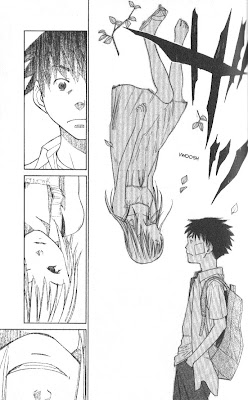
But perhaps the biggest draw of this series for me is the art by Adachitoka, whom Kawashima describes in the afterword as a "rookie artist" with "great talent and potential." I'm unaware of any other manga series Adachitoka has worked on, but to me his work looks like that of a seasoned pro. His character designs and figure work are strong, and I'm impressed by his striking panel layouts and page compositions. For example, this page where Taisuke Kanou witnesses a girl falling to her death right in front of him really stuck with me:
Adachitoka is equally adept at displaying comedy moments as he is at horror and action, so he's a perfect fit for this series that shifts tones quickly and frequently.
[Throughout the first volume, I was trying to place which American artist Adachitoka's style reminded me of. Pat Ollife? Kano (circa Action Comics 2000-2001)? An early Marc Silvestri? I was never able to pinpoint who he reminded me of, and by the second volume such comparisons didn't even occur to me. Is it just me or do these mental comparisons pop up in anyone else's head when they're exposed to an artist's work for the first time? A similar thing always happens to me when I go to see live theatre: During the intermission I turn to my wife and rattle off which TV and movie actors the cast members remind me of.]
Azumanga Daioh: The Omnibus - I just got this today and barely started reading it but I already love it. It doesn't have the same energy and incredible charm as Kiyohiko Azuma's other work, Yotsuba&!, but the four-panel format is surprisingly effective: it's really easy to settle into a rhythm reading the strip and just let the character-based comedy wash over you. (In a way, it's like watching a pleasant, diverting sitcom, only here the fourth and final "gag" panel takes the place of the laugh track kicking in every few seconds.) Recurring thought while reading the collection so far: What would Josh Fruhlinger say about these strips?
Kekkaishi: Volume 11 - A full, meaty volume. I thought Tanabe did a good job addressing different characters' reactions to Gen's death, and there was definitely progression in the two camps' battle plans. And this was the first volume where I actually found myself liking Yoshimori, in part because Gen's death makes him appear more vulnerable and sensitive, but also because Yoshimori finally takes the initiative in training (even if he's not very organized in the way he goes about it) and in engaging the enemy. (I won't spoil what he does, but Tanabe executed one of my favorite "headstrong hero" stock moves.) Only downside: the return of My Evil Pony! NOOOOOO!!!! Wasn't he destroyed or something? No fair that these Ayakashi can regenerate so easily!
Alive: Volumes 1 & 2 - I'd forgotten that Katherine Dacey-Tsuei sent me the first volume of this series months ago. I finally read it the other night and then tracked down the second book the very next day. Alive is an absorbing entry in the "students merge with nefarious aliens and gain extraordinary abilities" genre (see also: Parasyte, Shadow Star, Alien Nine, Q-Ko-Chan). Writer Tadashi Kawashima keeps the action moving along quickly and does a good job of creating suspense and uncertainty without ever lapsing into lazy obtuseness substituting for mystery. Yes, two volumes in and we're still in the dark about what's causing these abnormal events (mass suicides and superpowered killers), but things feel like they're progressing rather than spinning their wheels and dragging things out. For one thing, Kawashima does a good job of showing us multiple perspectives on the events, and he's effectively juggling a fairly large cast (it seems like new characters are introduced almost every chapter) without it feeling overcrowded.
But perhaps the biggest draw of this series for me is the art by Adachitoka, whom Kawashima describes in the afterword as a "rookie artist" with "great talent and potential." I'm unaware of any other manga series Adachitoka has worked on, but to me his work looks like that of a seasoned pro. His character designs and figure work are strong, and I'm impressed by his striking panel layouts and page compositions. For example, this page where Taisuke Kanou witnesses a girl falling to her death right in front of him really stuck with me:

Adachitoka is equally adept at displaying comedy moments as he is at horror and action, so he's a perfect fit for this series that shifts tones quickly and frequently.
[Throughout the first volume, I was trying to place which American artist Adachitoka's style reminded me of. Pat Ollife? Kano (circa Action Comics 2000-2001)? An early Marc Silvestri? I was never able to pinpoint who he reminded me of, and by the second volume such comparisons didn't even occur to me. Is it just me or do these mental comparisons pop up in anyone else's head when they're exposed to an artist's work for the first time? A similar thing always happens to me when I go to see live theatre: During the intermission I turn to my wife and rattle off which TV and movie actors the cast members remind me of.]
Azumanga Daioh: The Omnibus - I just got this today and barely started reading it but I already love it. It doesn't have the same energy and incredible charm as Kiyohiko Azuma's other work, Yotsuba&!, but the four-panel format is surprisingly effective: it's really easy to settle into a rhythm reading the strip and just let the character-based comedy wash over you. (In a way, it's like watching a pleasant, diverting sitcom, only here the fourth and final "gag" panel takes the place of the laugh track kicking in every few seconds.) Recurring thought while reading the collection so far: What would Josh Fruhlinger say about these strips?
Labels: Kekkaishi, Manga, Reading Habits, Reviews
11:19 PM | |
Wednesday, October 03, 2007
All Matt Thorn, All The Time
Matt Thorn is at it again, offering information in my comments that's much more interesting and informative than anything I'm writing on the main blog. Here's a follow-up comment to his earlier edifying elucidation:
And to illustrate the point he's talking about with shifting panels over to make sure the horizontal and vertical gutters don't form a cross, here's a page from Kekkaishi, again stolen from one of Shaenon K. Garrity's fabulous Overlooked Manga Festivals:

Compare that with another page from What's Michael?:

I don't know if it makes much difference to Western readers, but I can see how making it clear that the panels are supposed to be read across (rather than up-down) would be important to Japanese readers.
Matt Thorn is at it again, offering information in my comments that's much more interesting and informative than anything I'm writing on the main blog. Here's a follow-up comment to his earlier edifying elucidation:
Glad you found the comment useful. Looking at the page Pope did, I can see a few things that a Japanese editor would balk at. First, it's not immediately clear who the target audience is. Adults? Boys? Girls? The "splash" doesn't convey much information. The drawing style is rough and yet somewhat realistic, suggesting an adult readership. The characters are girls in school uniforms, implying it may be targeted at girls. Yet the visual gag seems rather juvenile, suggesting the target may be boys. The target audience determines to a large degree how the opening should be presented. The second thing I find jarring is the use of a "thought balloon." Thought balloons of this kind went out of style many years ago, and are used today only as pastiches or gags. The fact that we "see" KC's thoughts also immediately suggests that the story is told from her point of view, yet all the other visual information suggests that it is JP who is the protagonist. A Japanese artist would overcome this obstacle by simply having KC speak the thought out loud in a regular speech balloon. (Similarly, manga artists today only attach "arrows" to speech balloons when not doing so might leave the reader confused about who is speaking, so the only balloon here that might require an arrow is JP's in the bottom left panel.) There are several other seemingly trivial things that would bother me if I were the editor. I think the editors must have found themselves in a Catch 22 situation. They wanted to present non-Japanese comics creators, yet they also had to meet a certain minimum of reader expectations. Let the artist do what he wants, and you alienate the bulk of your readers. Tinker with the work too much and you end up with a sub-par manga, which defeats the whole purpose of inviting foreign artists to contribute in the first place.Someone get this guy a blog! (Or a publisher for his Never-Ending Manuscript on Manga.)
It's funny you picked that particular page of What's Micheal. The work is pretty old (about 20 years?) and was originally intended for an older audience, so at the time neither editor nor reader would be bothered, but today this page wouldn't pass editorial muster because of the very first panel. (Note that the page has been flopped in the translated edition.) The gutters between that panel and the adjacent panels form a perfect cross, which would leave the modern manga reader wondering whether the second panel is the one to the right or the one below. To make clear that the top right panel is panel number 2, the gutter between the top two panels would have to be shifted at least a quarter of an inch or so to the left or right. The order of the panels is obvious from context, but the reader still needs to stop for a few milliseconds and wonder, which means the artist has screwed up. The reader should be able to follow the flow of the panels automatically and unconsciously, so that the reader's absorption in the story is never broken.
As you point out, all these rules can be both stifling and helpful, and this is the dilemma of the Hollywood Syndrome (tm). Most critics would agree that Joe Sacco's Safe Area Gorazde is more powerful than Joe Kubert's Fax from Sarajevo, but the average Joe or Joanne on the street would find the latter easier to read. Spielberg, in making Schindler's List, had to break or bend many Hollywood rules (some of which he created himself) in order to keep it from becoming just another slick drama to be viewed objectively as entertainment. Ditto with Spiegelman's Maus. Similarly, a manga artist like Taiyo Matsumoto or Kiriko Nananan has to break or bend some manga rules to achieve something striking and different, but adhere to other rules in order to get the work published and actually read by a fair number of people.
And to illustrate the point he's talking about with shifting panels over to make sure the horizontal and vertical gutters don't form a cross, here's a page from Kekkaishi, again stolen from one of Shaenon K. Garrity's fabulous Overlooked Manga Festivals:

Compare that with another page from What's Michael?:

I don't know if it makes much difference to Western readers, but I can see how making it clear that the panels are supposed to be read across (rather than up-down) would be important to Japanese readers.
Labels: Kekkaishi, Manga, Matt Thorn, People Smarter Than Me, Reader Responses
9:26 AM | |
Monday, August 20, 2007
Kekkaishi Cheers & Jeers
Cheers! to the Young Adult Library Services Association (YALSA) for naming Kekkaishi as one of its nominees for 2007's Great Graphic Novels for Teens! The full list is here, while ComiPress has a list of just the manga nominees. (And extra Cheers! to David Welsh for pointing this out to me in the first place!)
Jeers! to Kekkaishi Volume 10 for including one of the worst character designs I've ever seen:

It's My Evil Pony, the Dark Centaur Version!
And right after I went on and on about how great the character designs in Kekkaishi were, too! (This always happens to me after I recommend something. Yes, I'm the one who's responsible for all of your favorite TV shows suddenly sucking in midseason.) At least the story is still good. As Katherine Dacey-Tsuei pointed out in her review, this is the installment where it all starts to hit the fan. You know a manga is skillfully crafted when it can still surprise you even after you feel like you've seen the same old storytelling tricks over and over again.
Labels: Character Designs, Kekkaishi, Libraries, Manga
11:24 PM | |
Wednesday, August 08, 2007
Another Image-Heavy Kekkaishi Post:
The Joy of Great Character Designs

Tanabe draws Masamori as such an attractive guy that I've developed a bit of a fictional mancrush on him:

Tanabe's villains are also strangely attractive. Consider this villainess, who somehow manages to be both spooky and sexy even though she lacks the traditional "bad girl" massive mammaries:

Here are a couple other designs that caught my eye:

Creepy old scholar guy, who apparently has some unusual sexual proclivities looked down upon by other characters

Some bad guy demons who have adopted human form.
Finally, in the omake at the end of volume two, Tanabe offers a fascinating look at character designs that could have been:


Even better, Tanabe images how differently the manga would have read if she had gone with alternate designs:

After growing accustomed to the characters' "normal" looks, it's a bit odd to see other characters acting out their parts. It's like watching a horribly miscast remake of a favorite old show.
The Joy of Great Character Designs
One of the things I love about Kekkaishi are the distinctive character designs. Creator Yellow Tanabe does a wonderful job creating memorable and fitting looks for each character. One of my favorite characters in the book is Tokine, the childhood friend and next-door neighbor of the series' main protagonist, Yoshimori. Tokine is older and more mature than Yoshimori, and it shows in the way Tanabe depicts the two characters: whereas Yoshimori's impatient temperament is betrayed by his unruly hair and forward-leaning motion, Tokine's sensibly pulled-back straight hair and solid stance convey confidence and stability. Unlike many manga heroines, Tokine isn't ditsy or unsure of herself. And don't even think of sneaking an upskirt peek at her panties:


My only complaint about Tokine's character is that sometimes she's written as mentally marveling at Yoshimori's untapped / unrefined prowess. Those bits are annoying for two reasons: First, it comes across as a clunky moment of the writer trying to convince readers how great the main character is. (Don't tell us how great the character is; just show us.) Second, it makes Tokine look like she's fawning over Yoshimori as being naturally great even though he doesn't bother to train or take his responsibilities seriously like she does. (As you can probably guess, Yoshimori isn't my favorite character. He suffers from what I term "Manga Manifest Destiny Syndrome" where slacker characters expect to become really good at something simply by virtue of wanting it really badly. And generally those characters do get what they want, since they just so happen to have some amazing innate talent. Still, while I don't like Yoshimori much considered in his own right, he is a decent foil for the rest of the cast to react to.)
Back to characters I do like, here's Yoshimori's older brother Masamori, who's so cool he can take time to answer his cell phone in the middle of battling a many-limbed monster.
Back to characters I do like, here's Yoshimori's older brother Masamori, who's so cool he can take time to answer his cell phone in the middle of battling a many-limbed monster.


Tanabe's villains are also strangely attractive. Consider this villainess, who somehow manages to be both spooky and sexy even though she lacks the traditional "bad girl" massive mammaries:

Here are a couple other designs that caught my eye:

Creepy old scholar guy, who apparently has some unusual sexual proclivities looked down upon by other characters

Some bad guy demons who have adopted human form.
Finally, in the omake at the end of volume two, Tanabe offers a fascinating look at character designs that could have been:


Even better, Tanabe images how differently the manga would have read if she had gone with alternate designs:

After growing accustomed to the characters' "normal" looks, it's a bit odd to see other characters acting out their parts. It's like watching a horribly miscast remake of a favorite old show.
Labels: Character Designs, Kekkaishi, Manga
5:13 PM | |
Wednesday, August 01, 2007
And So It Begins
 After growing spoiled with Bleach releases that were only two months apart, it looks like there will now be a five month gap between volumes 21 (10/2/07) and 22 (3/4/08). No idea if this longer delay will become the norm between volumes, but based on the fact that Bleach is now being serialized first in the monthly Shonen Jump, I think the release schedule would have to slow down. (Various fans have speculated that a slowdown would have occurred even without the SJ serialization because the American releases were catching up to the Japanese volumes.)
So how is a Bleach fan supposed to while away the months between volumes? Here are a few suggestions. (Feel free to add your own in the comments.)
 Catch up with the anime. By Sept. 25, the sixth DVD will be out, which covers up to the 24th episode, and the season one boxed set containing the first five discs (20 episodes) comes out a little after that in October. I've only watched the first DVD and wasn't that impressed, but I remember watching snippets of later episodes via BitTorrent and it looked like the animation quality had improved, so I might be tempted to check out more of the series.
Catch up with the musical. In addition to the episodes available on YouTube, there's also the official musical site, which has some interesting features. I especially like the opening animation on the subsite for the "Blue Heavens" production where the illustration of key characters by Tite Kubo is replaced by photos of the corresponding cast members in full Bleach costume.
Catch up with the merchandise. Viz (apparently sensing my anxiety over the upcoming delays) just sent me an email reminding me about all the Bleach merchandise available for purchase through the online Viz store. What better way to ease your Bleach withdrawal symptoms than by crying into your Kon plushie every night?
 Catch up with the fansites. I'm completely out of it when it comes to all the LiveJournal fansites that are out there for various manga and anime, but I did manage to stumble across one called Soul Society that at least has a nice-looking design. I'm a bit nervous about digging too deep into any Bleach fanfic, and I don't want to spoil anything by stumbling across advance scanlations, but who knows how adventurous I'll become when it's still months until the next volume comes out?
Catch up with the other Shonen Jump features. If you're an obsessive Bleach fan like me, you know you're going to break down and subscribe to SJ so you can read the material as soon as it's available, so you may as well speed up the process by familiarizing yourself with the other manga serialized in the monthly anthology. It'll make the transition easier and more enjoyable if you're already up-to-date with the other series once the subscription kicks in.
 Catch up with Kekkaishi. Back when I first read this other Viz manga featuring a superpowered teen who fights wayward spirits, I was a bit dismissive towards it, basically referring to it as "Bleach lite," but Yellow Tanabe's series has really come into its own lately. There are still similarities to Bleach — for example, there are political machinations going on in a shadowy organization reminiscent of the Soul Society — but the tone and execution is very different from Tite Kubo's epic. For one thing, there's more space devoted to a smaller core cast of characters, which means more opportunities for deeper characterization. And Tanabe's art is very different from Kubo's, more solid and weighty as opposed to fluid and fast. I haven't read the latest volume yet, since I've been following the series through the library and they're slow to get the newest releases. But Katherine Dacey-Tsuei's review of volume ten (scroll down) makes me think I'm not going to be able to wait to read this for free. (For more background on how great Kekkaishi is, make sure to check out Kate's super-sized review of the first nine books!) And looking at the sales charts, I can tell that not enough of you are reading Kekkaishi, so get cracking and rectify this oversight ASAP! (Actually, I guess I have to point the finger at myself since I've been reading this series through the library rather than purchasing it myself. Oops.)
Labels: Bleach, Kekkaishi, Manga, Scheduling Grumbling, Viz
10:19 PM | |
Thursday, July 26, 2007
SNP, CRCKL, PP!
Recently I was reading Kekkaishi Volume 9 and I noticed something interesting: many of the sound effects were actual words with the vowels completely removed. So, for example, "RUMBLE" was written as "RMBL." I went back and looked at the volumes I had on hand (6-9, all from the local library) and it looks like something that's been slowly building throughout the series. For example, in earlier volumes certain sound effects were fully spelled out (e.g., "RUSTLE") but in later volumes the same SFX was abbreviated:
Here are some of my other favorite consonant-only SFX from Kekkaishi:
Can anyone explain that last one to me? "GRMP" is used a couple times in the book in situations where one character is grabbing or gripping another, but I can't figure out if it's supposed to represent an actual word or if it's just a more traditional "nonsense" SFX creation.
And if anyone has earlier volumes of Kekkaishi, could you check to see if this has been going on from the book's beginning and it just took me until volume nine to notice? Also: has anyone noticed Viz (or any other publisher, for that matter) using similar SFX shorthand in any other series? Personally, I kinda like this method of transcribing sounds, as it make them look less like "real" words and more like "pure" sounds. 11:55 AM | |
Recently I was reading Kekkaishi Volume 9 and I noticed something interesting: many of the sound effects were actual words with the vowels completely removed. So, for example, "RUMBLE" was written as "RMBL." I went back and looked at the volumes I had on hand (6-9, all from the local library) and it looks like something that's been slowly building throughout the series. For example, in earlier volumes certain sound effects were fully spelled out (e.g., "RUSTLE") but in later volumes the same SFX was abbreviated:
 |  |
| RUSTLE | RSTL |
 |  |
| MURMUR | MRMR |
Here are some of my other favorite consonant-only SFX from Kekkaishi:
 |  |
| KLNCH | SKRTCH |
 |  |
| KRMPL | CHCKL |
 |  |
| RMBL | GRMP |
Can anyone explain that last one to me? "GRMP" is used a couple times in the book in situations where one character is grabbing or gripping another, but I can't figure out if it's supposed to represent an actual word or if it's just a more traditional "nonsense" SFX creation.
And if anyone has earlier volumes of Kekkaishi, could you check to see if this has been going on from the book's beginning and it just took me until volume nine to notice? Also: has anyone noticed Viz (or any other publisher, for that matter) using similar SFX shorthand in any other series? Personally, I kinda like this method of transcribing sounds, as it make them look less like "real" words and more like "pure" sounds. 11:55 AM | |
